
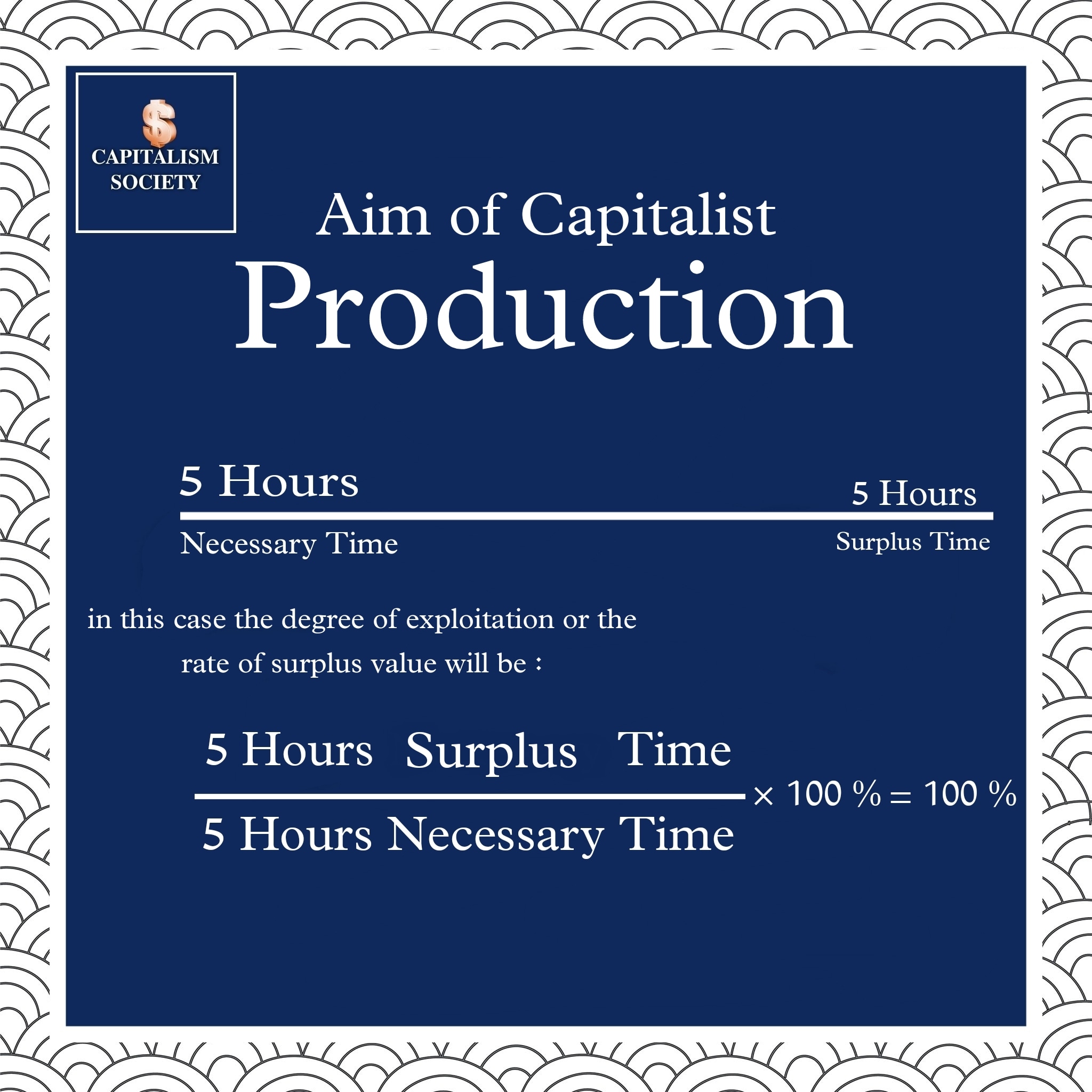
The conversion of surplus value into capital and its use for producing new surplus value is the aim of capitalist production . Capitalists always strive to obtain as much surplus value as possible with the least possible expendi tures . They use every possible means to achieve this aim . Capital displays inordinate greed for surplus labour . Accord ing to a British trade union leader , capital fears the absence of profit or too small a profit as nature fears a vacuum , but as long as there is a sufficient profit , it becomes audacious ; if you guarantee capital a 10 per cent profit , it will agree to any application ; a 20 per cent profit enlivens it ; at a 50 per cent profit it is virtually ready to break its neck ; at a 100 per cent profit it tramples all human laws , and if it could make a 300 per cent profit , there is no crime which it would not risk even on pain of hanging . The pursuit of surplus value was a powerful stimulus to the development of production unknown to either the slave owning or the feudal society . This stimulus created a large scale industry first in Europe and in North America and then throughout the world . At the same time the pursuit of surplus value engendered contradictions between capitalists and the workers and imparted an antagonistic the character to the development of capitalist production . For a capitalist only that labour is productive which produces surplus value . In order to increase the surplus value each capitalist strives to squeeze as much surplus labour out of the workers as possible . There are two methods of increas ing the surplus value . Let us examine them on a concrete example . Let us assume that the working day lasts 10 hours of which 5 hours are the necessary labour time and 5 hours are the surplus labour time .

 Capitalism Society