By the middle of the 19th century the natural and social sciences had reached such a level of development that it was possible to create a truly scientific philosophy – a science about the most general laws of development of nature and society . The natural sciences showed that the world had not been created by anybody , but had developed according to its own laws . For example , physics discovered the law of universal gravitation which governs all natural phenomena , while chemistry discovered the law of conservation of matter , according to which nothing is created in the world and nothing disappears without leaving a trace , everything merely changing the form of its existence . The advance of natural sciences helped the further development of materialism and dialectics . The greatest contribution to materialist philosophy was made by the German philosopher Ludwig Feuerbach ( 1804 1872 ) . Georg Wilhelm Friedrich Hegel ( 1770-1831 ) , another German philosopher , generalised the method used by the modern sciences in analysing the phenomena of nature and society and raised dialectics to a new level ; according to Hegelian dialectics everything must be considered from the point of view of continuous change and development . However , neither Feuerbach nor Hegel could create a truly scientific philosophy . Feuerbach , for example , did not recognise dialectics and thereby rejected the method of cognition used by science , whereas Hegel adhered to idealist positions and persisted in the opinion that , according to the laws of dialectics , it was not nature and society , but some Absolute Idea that developed . Moreover , he limited the development of this idea to the creation of the Prussian constitutional monarchy , considering it the highest expression of the Absolute Idea and the acme of development of society .
Since the beginning of the 19th century , i.e. , since the coming of large – scale machine industry into existence , the economy of capitalist countries is periodically shaken by economic crises . The first economic crisis that involved the entire economy of the country occurred in England in 1825 . In 1836 England was shaken by a new crisis which also spread to the U.S.A. The next crisis occurring in 1847-48 was a world crisis . It was followed by the crises of 1857 , 1866 , 1873 , 1882 and 1890. In the 20th century crises occurred in 1900-03 , 1907 , 1920-21 , 1929-33 and 1937-38 . Since World War II the U.S.A. , for example , had four crises ( 1948-49 , 1953-54 , 1957-58 and 1960-61 ) . The 1957-58 crisis was a world crisis involving countries accounting for almost two – thirds of the industrial output of the capitalist world . The economic crises under capitalism are overproduction crises . During a crisis the goods have no market because more goods have been produced than can be purchased by consumers whose purchasing power is limited . The over production of goods does not in any way mean that the needs of all members of society have been satisfied . On the contrary , during a crisis the working people find themselves in particularly difficult straits and their living standards are sharply affected . Because of the growth of unemployment enormous numbers of people are completely deprived enormous of all means of subsistence . The excess of goods does not apply to the real needs of society , but to the inability of the population to buy these goods ; the overproduction of goods during a crisis is therefore relative . The economic crises of overproduction are based on the contradiction between the social character of production and the private – capitalist form of appropriation of the results of production . Millions of people work at capitalist enter prises , but all they produce belongs to the owners of the enterprises . However much a worker may produce he can buy only the amount his wages enable him to buy . In pursuit of the greatest profits capitalists expand pro duction , perfect the technology and throw quantities of goods on the market . But the increase in the workers ‘ wages , if they increase at all , lags behind the growth of production . This means that the effective demand of the working class , the broad masses of the working people , relatively decreases . The expansion of capitalist production inevitably runs into the limited consumption capacity of the main masses of the people . The main contradiction of capitalism manifests itself in the class antagonisms between the proletariat and the bourgeoisie . The characteristic capitalist discrepancy between the two most important conditions of production – between the means of production concentrated in the hands of the capitalists and the direct producers deprived of the means of production and owning only their labour power – shows itself particularly clearly in the crises of overproduction with an excess of the means of production and products , on the one hand , and an excess of labour power , a mass of unemployed deprived of the means of subsistence , on the other . The crises aggravate the class antagonisms between the proletariat and the bourgeoisie , and between the peasants and the landowners who exploit them , the class struggle in capitalist society intensifies , and broad masses of the working people take part in this struggle . Crises are an unavoidable concomitant of the capitalist mode of production . They cannot be eliminated as long as capitalism exists . They indicate very clearly that the productive forces created by capitalism have outgrown the bourgeois production relations with the result that the latter have become an impediment to the further growth of the productive forces . To ensure this growth , it is necessary to abolish capitalist private ownership of the means of production and the capitalist production relations . By developing the productive forces and socialising production capitalism objectively creates the material prerequisites for socialism . At the same time it engenders the force which is destined to transform society . This force is the working class .
Some philosophers , absorbed in mathematics , a science which demands a great amount of abstract thought , became the protagonists of an idealist trend in philosophy . They used mathematics to construct various idealistic concepts ; thus , they evolved the ” magic ” of numbers . Pythagoras and his followers ( 6th century B.C. ) were the first idealist – philosophers . They imbued figures and mathematical concepts with mystical qualities . According to their beliefs , the number ” 1 ” stood for evil , ” 2 ” stood for good , ” 10 ” was perfection , etc. Representatives of the idealist school in the city of Eleia , a Greek coldhy in Southern Italy , attempted to prove the immobility of all matter .
The Functions of the State The main function of the slave state ( as of all other exploit er systems ) was the suppression of the exploited . In order to capture new slaves the slave states waged constant wars , plundering the defeated peoples , turning them into tributaries or slaves . Herein lies the second function of any state based on the exploitation of man by man : the expansion of its territory . The state carries out its functions with the aid of a state apparatus . To begin with , the state adopted some clan and tribal institutions ; however , they no longer reflected the interests of the entire clan or tribe but only those of a small group of clan elders and tribal chieftains who eventually became hereditary rulers . The military force of the primitive , communal system was composed of all the able – bodied members of the clan , while in a slave system there appeared a new force , removed from the people and standing in opposition to it : a paid army whose duty it was to defend the rapacious , egotistic interests of the slave – owners . The courts appeared in like manner , the guardians of the interests of an insignificant part of society , the slave – owners , not the interests of society as a whole . The clergy were an integral part of the state apparatus , as were the overseers , guards , scribes , collectors of duties , taxes , etc. The former division of the population along lines of blood relationship was now supplanted by an administrative and territorial division .
One of the main economic features of imperialism is the export of capital . Export of goods was typical of pre – monopoly capitalism when free competition had undivided sway . Under monopoly capitalism foreign trade continues to expand , but the export of capital acquires exceptional importance . During the period of monopoly capitalism the export of capital becomes the main instrument of systematic exploitation of the greater part of the world by a handful of eco nomically developed capitalist countries . Vast amounts of ” surplus capital ” arise in a number of capitalist countries . Under imperialism the domination of monopolies with their enormous concentration of capital , and the development of joint – stock companies and banks which concentrate vast amounts of the population’s free money give rise to ” sur plus capital ” in a number of capitalist countries . This ” sur plus capital ” is conditional and relative . The living standards of the masses of people under capitalism remain comparatively low , while agriculture , which greatly lags behind industry , is very much in need of money for its develop ment . But monopoly capitalism cannot use the ” surplus capi tal ” to raise the living standards of the people because that would reduce the profits of the monopolists . In pursuit of higher profits the monopolies export capital . In the beginning of the 20th century capital was exported mainly to the backward , colonial and dependent countries where the scarcity of capital , low land prices , low wages and cheap raw materials ensured fabulously high profits . Capital is still being exported to underdeveloped countries . Between 1946 and 1960 the U.S.A. withdrew from Latin American countries 8.800 million dollars of profits , whereas the new American direct private capital investments in Latin America during the same period amounted only to 4,500 million dollars . Export of capital from one highly – developed capitalist country to another has been rapidly developing in recent years be cause of intensified competition and the difference in wages . Capital is exported in two basic forms : firstly , as productive capital consisting in investments in industry , agriculture , transport , etc. , and , secondly , as loan capital , i.e. , loans to governments and private credit . Despite the different forms of export of capital its exporters pursue the same aim , namely , to obtain high monopoly profits . Both private and state capital may be exported . In the beginning of the 20th century the export of capital was almost entirely private business . Today state capital amounts to about half the total export of capital and continues to increase because private capital prefers to take no risks in connection with the increasing danger of nationalisation in the liberated countries . Imperialist states use export of capital to extend the old and seize new sources of raw materials . markets and spheres of capital investments , and to effect eco nomic , political and military strategic expansion .
The development of commodity – money relations was the basis on which the Russian centralised state was created . The united Russian market evolved in the 18th century , but its sources go back to the 16th century , when town crafts and local markets entered a period of rapid growth . In the early 1580s there were close to 200 various crafts in Novgorod and close to 100 in Kazan . The main feature of craft pro duction was its great diversification . The metal workers were subdivided into pin – makers , button – makers , etc .; there were bow – makers , sword – makers , dagger – makers , etc .; in the manu facture of clothing there were specialists for every garment worn . The social division of labour brought about an increase in trade . In the 16th century many Russian towns were major trading centres . In Pskov in the 1560s – 1570s there were a trading court , where most of the commercial transactions took place , and a total of 1,300 other trading premises ; in Kazan there were 644 ; in Kolomna , near Moscow , there were close to 450 . Peasants brought their produce to the market in town . Local markets began establishing ties among themselves . Thus , there were the so – called trading courts , known as the Tver and Pskov Courts , in Novgorod in the 16th century . There were fairs in some regions . Moscow , which had become a major centre of crafts and trade in the 15th century , was the binding link in inter – city trade . Foreign trade was fast developing . There were many trade routes to the Baltic regions . The Volga route connected the European markets with the Caspian area and Central Asia . The development of commodity – money relations created a more complex social structure of society and increased differentiation among the craftsmen , merchants and peasants . The leading merchants formed a separate estate , the mer chants ‘ guild , and two privileged ” hundreds of merchants and cloth – makers . Documents of the time mention ” middle ” merchants and town craftsmen , as well as ” black people ” , the poorest stratum of the population . In the villages a stra tum of wealthier peasants emerged from among the serfs , having bought their freedom from their masters ; these peas ants often became craftsmen or merchants .
The nature of production relations determines the economic system of a given society . This economic system is the basis on which the various social relations , ideas and institutions arise , for the mode of production eventually determines all aspects of life in a given society . First , the basis determines the political and legal institutions and organisations which depend upon the class structure of society ( the state , church , political parties , etc . ) – everything that constitutes the political superstructure of society . Then it determines the various ideas of society ( political , legal , philosophical , religious , artistic , etc . ) – everything that constitutes the ideological super structure of society . Since the basis determines the superstructure , it follows that every change of basis entails a change in superstructure , i.e. , in the existing political institutions and ideology . How ever , the superstructure , though dependent upon the basis , can in turn influence production relations and can either accelerate or delay their replacement . Every society is thus an integral organism , a socio – economic formation , a definite historical type of society with its own distinctive mode of production , basis and superstructure . The basis of the slave state , as of the feudal and capitalist states , is antagonistic , since it is founded on private owner ship of the means of production and the exploitation by the ruling class of the producers of material values . That is why the socio – economic formation of the slave state in general is an antagonistic , exploiter formation .
Beginning of the Working – Class Movement in France
Although the bourgeois revolution in France destroyed the foundations of feudalism , it left quite a few of its survivals in economic and political life . Politically France was a more backward country , its monarchy having been restored after the defeat of Napoleon . The power of the king was restricted by parliament consisting of two chambers – the chamber of peers , whose members were appointed by the king , and the chamber of deputies who were elected by persons with annual incomes of at least 300 francs and living in the given area for a definite length of time . The deputies had to have an annual income of at least 1,000 francs . Naturally , that predetermined the composition of the parliament which acted in concert with the king and in the interests of the landowners . The king and parliament encouraged high prices heavy industry . on timber , of which charcoal was then being made for metallurgy , and thereby hampered the development of the The French government was also opposed to any agrarian reform . Agriculture played the most important part in the life of the country because industry was not yet sufficiently developed . But it was a small – scale , scattered agriculture , and capitalist methods of production were used only on one – third of the cultivated lands . Further development of agriculture was hindered by the half – rent system , according to which the tenant had to give the landowner half the crop . The tenants were therefore not interested in increasing the yield and the marketable surplus of agricultural production . Moreover , the government imposed on the peasant economies excessively high taxes which hampered the develop ment of commodity production . Further development of the French economy depended on a change in the political system , which was demanded by the industrial bourgeoisie and the proletariat . The French proletariat had gone through a good school of struggle against despotism and oppression and therefore actively joined the struggle against the existing system . The most class – conscious proletarians joined political clubs organised by the radical bourgeoisie . These clubs discussed the inter nal situation in the country and elaborated a programme for setting up a new government . But even the radical bourgeoisie refused to consider questions of raising the Wages , shortening the working day , improving the housing conditions , etc. The workers therefore began to organise their own clubs and to discuss the questions which were of interest to them . But they did not confine themselves to mere discussions . Driven to despair by their distressing material conditions , they often rose in arms against the existing system and their employers . For example , in 1831 the workers came out into the streets of Lyons demanding a raise in wages , but were fired upon by the troops . The workers seized arms , captured the city and established their own rule . The uprising was soon suppressed , but the Paris workers revolted the very next year , and in 1833 the proletarians of Lyons rose in arms again .
The Lyons uprisings showed that a new political force the working class – had entered upon the historical arena ; the workers began to realise that the interests of the bourgeoisie were opposed to the interests of the proletariat . After the Lyons uprisings the government passed a law prohibiting working – class organisations . The workers began to organise illegal societies . An organisation called Seasons and numbering about 4,000 or 5,000 members came into existence in Paris in 1839. The organisation was not connect ed with the masses and that was why , when its adherents tried to seize power on May 12 , 1839 , they were able to capture only the town hall with one police post , after which they were dispersed by gendarmes . The French government stubbornly refused to consider the demands of the people . The discontent with the government’s policy increased with each passing day . A revolution was impending in France .
The evolution of slave – owning resulted in the establish ment of a whole system of slave trading . Slave markets sprang up in Rome and in other regions . Foreign trade prevailed . Agricultural produce and luxuries were imported from the many Roman ” provinces ” ( conquered regions and dependent countries ) , while Rome exported metal implements , wine and olive oil . Imports were greater than exports . However , the lack of exports was compensated for by outright pillage of the conquered lands and , in particular , by the influx of large sums of money . By seizing the silver mines of Spain , Rome was provided with a permanent source of mint . The growth of commerce and money in circulation Created usurious capital . Companies of tax – farmers , the so – called publicans , were formed to carry out various operations involving credit and usury . Money – changers ‘ shops , sprang up everywhere . Their owners not only changed coins , but banked money , provided loans at an interest and remitted sums . Persons whose occupation was commerce and usury gradually formed a separate estate of the ruling class ,
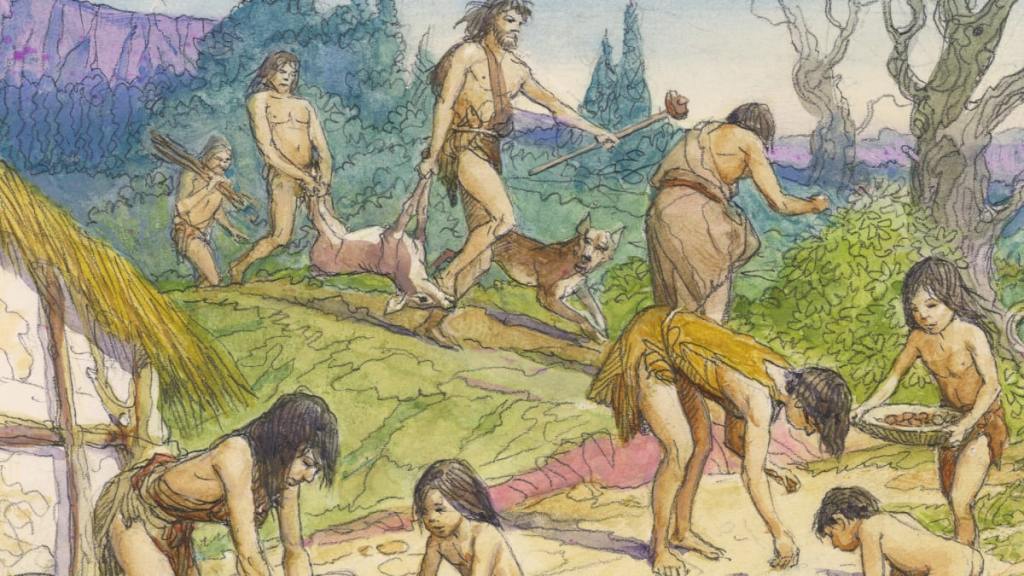
Beginning with the 700th millennium B.C. , man began to fashion his first tools from stone . Later , he cracked and crushed stones to make his first crude stone implements with a cutting edge . Besides these primitive stone tools he also fashioned wooden tools such as sticks with sharpened tips , clubs , etc. From now on man consistently improved his tools to fit his purposes . He would sharpen both sides of a stone to make a chopper , a large universal tool with which he could chop , cut , strike an enemy and even dig . Such tools were made and used by a type of fossil man close in develop ment to the Pithecanthropus . At this stage , the invention of the chopper was man’s greatest achievement . The next stage in man’s evolution and in the development of the production of material values took place 500,000 to 300,000 years ago , when the first sharp oval choppers , chipped from all sides , came into use as did basically new tools especially fashioned for striking , cutting , digging , etc. In order to fashion the various scrapers , spears and other tools , man had to be skilled enough to strike the stone he was working on with great accuracy . This proves that in the process of production the human organism evolved and its co – ordination was perfected . 🔷The introduction of new tools brought about a change in primitive man’s entire way of life . With the aid of these new tools he could hunt such large animals as elephants , rhinoc eroses , buffalo , stags and horses . Now he could extract more food from the same area than formerly , and this made it pos sible for him to remain in a given area for a longer period of time . Primitive man began to set up temporary camps in places conducive to hunting : near lakes and rivers , along animal paths and the edges of forests , using caves for shelter .🔹









 Capitalism Society