
In the 19th century archeologists discovered the remains of extinct , highly developed primates called Dryopithecinae , or tree apes . Charles Darwin , the great English naturalist , and his followers analysed the evolution of the animal world over the course of many centuries and used these discoveries to scientifically prove the biological relationship between man and the animal world , as well as man’s evolution from the highly developed tossil apes . The proof of this theory was to be found in the data provided by anatomy , embryology , paleontology and , specifically , by the basic similarity of skel etal structure , brain development and the composition of the blood of modern man and the anthropoid apes . The develop ment of modern science has proved the validity of this mate rialist theory magnificently .
Category: invention
Germany On The Eve Of The Revolution

Germany on the Eve of the Revolution In the 1840s there had as yet been no bourgeois revolution in Germany. The country was broken up into a number of independent states. The German Union formally unified 34 German states and four free cities. The supreme body of the Union was the Bundestag which exercised practically no power; It had no army, no legal rights and no diplomatic representatives abroad. The decisions of the Bundestag came into effect only after their approval by the heads of all the states and cities. In other words , no centralized state – basis for the development of capitalism – had as yet formed in Germany ; The country had no single internal market and the trade relations between the various German states were hampered by customs barriers. Under those conditions the development of capitalism in Germany encountered great difficulties . A customs union unifying 18 German states with a population of 23 million formed only in 1818-34 . The industry and cities developed slowly . For example , in the 1840s the 12 largest cities of Germany had a slightly larger population than Paris . In the middle of the 19th century the industrial revolution in Germany was only going through its initial stage. The German bourgeoisie was faced with the problem of carrying out a bourgeois revolution , creating a centralised state and winning power . However , the cowardly German bourgeoisie preferred not to raise the question of altering the political system , but to pursue a course of reforms . The German working class , which developed later than the working classes of England and France , began its struggle in the middle of the 19th century ; it tried to set up its own organisations and came out with its own demands . Owing to the severe police regime the German workers set up their organisations abroad , in Switzerland and England , where the political system was more democratic , and tried to guide the working – class movement from there . One of these organisations was the German People’s Union but , like the others , this organisation had weak ties with the workers of the German states and therefore could not exercise any practical guidance of the working – class movement . At the same time the workers began to struggle for their rights openly . The workers of Silesia ( the best developed area in Germany ) who lived under intolerable economic conditions rose against the capitalists in 1844 , but the government immediately dispatched troops to defend the interests of the exploiters . In the middle of the 19th century German industry advanced from the manufactory stage to machine produc tion , and its further development now depended on how rapidly feudalism was abolished in the country . Since the the necessary reforms , a government of the German Union was unwilling to carry out Germany . revolution was impending in Germany.
Man’s Tools Change
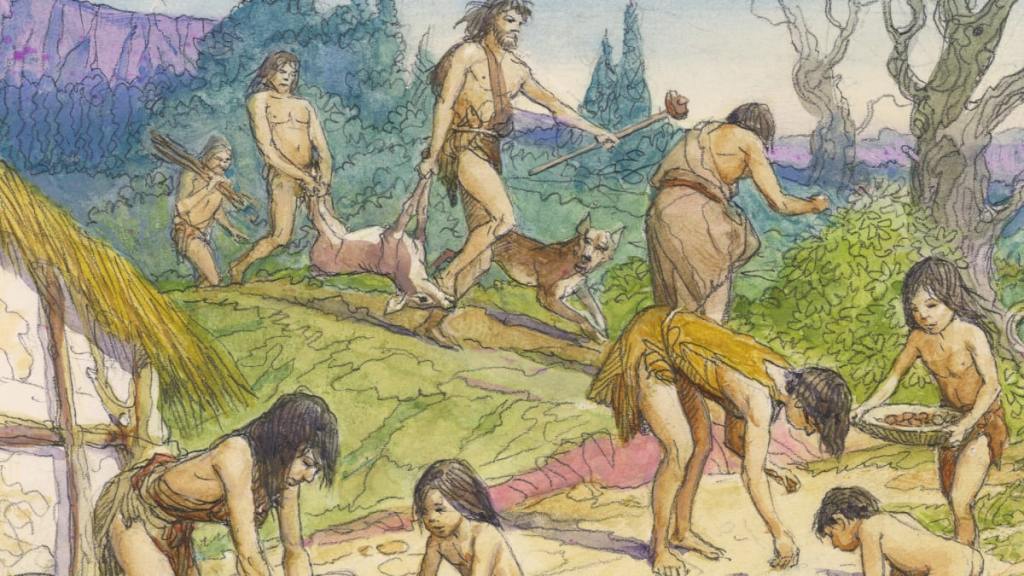
Beginning with the 700th millennium B.C. , man began to fashion his first tools from stone . Later , he cracked and crushed stones to make his first crude stone implements with
a cutting edge . Besides these primitive stone tools he also fashioned wooden tools such as sticks with sharpened tips , clubs , etc. From now on man consistently improved his tools to fit his purposes . He would sharpen both sides of a stone to make a chopper , a large universal tool with which he could chop , cut , strike an enemy and even dig . Such tools were made and used by a type of fossil man close in develop ment to the Pithecanthropus . At this stage , the invention of the chopper was man’s greatest achievement . The next stage in man’s evolution and in the development of the production of material values took place 500,000 to 300,000 years ago , when the first sharp oval choppers , chipped from all sides , came into use as did basically new tools especially fashioned for striking , cutting , digging , etc. In order to fashion the various scrapers , spears and other tools , man had to be skilled enough to strike the stone he was working on with great accuracy . This proves that in the process of production the human organism evolved and its co – ordination was perfected . 🔷The introduction of new tools brought about a change in primitive man’s entire way of life . With the aid of these new tools he could hunt such large animals as elephants , rhinoc eroses , buffalo , stags and horses . Now he could extract more food from the same area than formerly , and this made it pos sible for him to remain in a given area for a longer period of time . Primitive man began to set up temporary camps in places conducive to hunting : near lakes and rivers , along animal paths and the edges of forests , using caves for shelter .🔹
 Capitalism Society