๐™๐™ค๐™ฌ๐™–๐™ง๐™™๐™จ ๐™– ๐™๐™ฃ๐™ž๐™ฉ๐™š๐™™ ๐™๐™ง๐™ค๐™ฃ๐™ฉ

๐™๐™ค๐™ฌ๐™–๐™ง๐™™๐™จ ๐™– ๐™๐™ฃ๐™ž๐™ฉ๐™š๐™™ ๐™๐™ง๐™ค๐™ฃ๐™ฉ

An analysis of the situation in the country shows that objective conditions are ripe for the establishment of a united anti-monopoly front. But objective conditions alone are not enough. solution of

The growing consciousness of the masses and their active part in the political issues are highly essential. And in this much depends on us.

We must patiently explain that the brunt of the struggles should be directed against one central source of all our troubles. We must be able to show how it is that US capitalism is the root-source of these troubles. And how the large monopolies have taken over and dominate all phenomena in the fields of economics, politics, and the state

apparatus. We must clearly show how the policies of world imperialist enslavement are simply a continuation of the policies of exploitation at home, by the very same culprits namely, the U.S. monopolists.

We must make it clear to all that the concepts of peaceful co-existence, of disarma- ment, of cutting taxes and war budgets, of struggling for democracy are all tied together and dependent on the outlook of a retreat for U.S. monopolies’ policies of war. This understanding is necessary as a foundation to raise these struggles to new levels. But in order to achieve this we must lead the American people, and be able concretely to show them that these policies of imperialism are not to their benefit, not to their interest.

We can make great pronouncements but they will have very little effect if we fail to take note of feelings of national pride. Let us, for example, take the extremely impor- tant question of U.S. overseas bases. We must explain that their withdrawal is to the national interest of America as a nation, to every class, but above all to the working class. Without this we are going to fail.

It would be very effective to have delegations of American peace fighters meet with

peace fighters of Japan, of Great Britain, of Norway where these bases are, to show

mutual interest and to work out policies of mutual work to do away with these bases..

Somehow or other, we have to create the feeling that for the interest of the American people this dead weight must be cut loose. Let these bases sink and not sink the nation with them. We have ideas but we don’t have the handles. And the reason for that is that we

don’t have united front relations.

In order to establish the united front the whole energy of our Party should be released. And this means, in particular, that it must be released through the clubs. The latter are now the very centre of the Party’s work, and we should concretely examine what are the tasks of our clubs in the field of the united front relations. The same is true of shop clubs. We have to examine them in steel and in auto. The fact is that they cannot become the centre of the Party’s work without that concept. They cannot become growing bodies unless they have such relationships to the masses. They will remain dead, dull forms without it.

Further, we have to pursue a policy of coming closer with the left and progressive elements. For some reason we have lost contact with them. And without that we talk tall in the abstract and our policies don’t mean much. If you don’t influence those closest to you, you can’t influence broader sections of the masses.

We have to explode certain wrong concepts that have grown in our Party. Thus, for instance, there is an under-estimation of the left non communist groups in America. There is talk that they are small, they are isolated. But if we look around us seriously that becomes nonsense quickly. For in point of fact these groups are neither small nor isolated. They are quite a force in this country and it’s a growing force. We have movements around the language groups; there are tremendous areas of

movement for Negro rights; there are left elements in the unions and in the professional

field. There is a feeling that these forces are in competition with us. This is nonsense. As a
matter of fact the masses that follow the left forces tend to travel towards us. In most cases they will not come to us immediately. It is only natural. Very seldom do the masses come directly from politically unconscious strata to us. There are stations that they travel through and stop over for a while and then move on to us. So we must explode the idea that these forces are in competition with us.

Also, we cannot demand too much from these forces. We cannot demand, for example, communist standards in their understanding of the role of the Soviet Union, of the role of the Communist Party, U.S.A. This is wrong. Only from Communists can we demand communist understanding and communist standards.

It is necessary to re-examine the left forces very basically as a part of our united front policy. And we will inevitably arrive at the conclusion that the various separate movements and all the anti-imperialist struggles can potentially acquire a monolithic character. And this is an important base for the establishment of an anti-monopoly coalition.

U.S. imperialism has suffered a number of serious setbacks. These flow from and are the products of the new relationship of world forces. However, in the final analysis, it is the people of the United States who must take the aggressive policies of the imperialists of its own country into the historical woodshed.

The gateway to progress, to peace for the United States, is blocked by the policies of a group of greedy monopoly forces, entrenched in the economy, in the political life, in the military and in the government. These policies are in ever sharper contradiction to the interests of the people. As has happened on a world scale-the balance of weight between these forces will tip to the side of the people and against the forces of imperialism and war.

Those who steer America’s foreign policy cannot but reckon with the reverberations that their activities produce both on a world scale and in this country. And in this sense the masses of people in our country will, increasingly, influence the foreign policies of the United States.

This is how we must view the present-day developments in the life of our nation. We must see them in the context of the ever-changing balance of the world forces and the forces within the U.S.A., within the perspective of a declining phase in the epoch of capitalism; in the context of the rising phase of the epoch of socialism and communism.

๐Ÿ”ด Releted, โฌ‡๏ธ

Communist Party Of (CPO)

#CPOAustria,
#CPOBelgium,
#CPODenmark,
#CPOFinland,
#CPOFrench,
#CPOGermany,
#CPOGreatBritain,
#CPOGreece,
#CPOItalian,
#CPOLuxembourg,
#CPONetherland,
#CPONorway,
#CPOSpain,
#CPOSweden,

๐‘จ๐’„๐’‰๐’Š๐’†๐’—๐’†๐’Ž๐’†๐’๐’•๐’” ๐’๐’‡ ๐‘จ๐’ˆ๐’“๐’‚๐’“๐’Š๐’‚๐’ ๐‘น๐’†๐’‡๐’๐’“๐’Ž

(๐‘ณ๐’†๐’•๐’•๐’†๐’“ ๐’‡๐’“๐’๐’Ž ๐‘ฏ๐’‚๐’—๐’‚๐’๐’‚)

แด…แด‡แด€ส€ แด„แดแดส€แด€แด…แด‡๊œฑ,

๐‘จ๐’„๐’‰๐’Š๐’†๐’—๐’†๐’Ž๐’†๐’๐’•๐’” ๐’๐’‡ ๐‘จ๐’ˆ๐’“๐’‚๐’“๐’Š๐’‚๐’ ๐‘น๐’†๐’‡๐’๐’“๐’Ž

We know of the sympathy with which the whole world is following the revolutionary struggle of the people of Cuba. And your readers will undoubtedly be interested in hearing how the agrarian reform at the present stage the key to the Cuban revolution -is progressing.

The Agrarian Reform Law was proclaimed on May 17, 1950, in La Plata (Oriente Province) in the very same hut which sheltered Fidel Castro in the difficult days when, at the head of his valiant guerillas, he began the struggle against the Batista tyranny. A little over a year has passed since then, but this period of time, brief though it be, has seen some great successes. The people have swept away the numerous obstacles placed in their path by the reactionaries, that is, the North American imperialists, the lati- fundists, the big compradore bourgeoisie, a part of the agricultural bourgeoisie and the remnants of the supporters of the old regime. The mass of the people is solidly behind the agrarian reform, while the revolutionary government, relying on the people, is rapidly and unhesitatingly giving it effect.

The year 1960 has been proclaimed the year of agrarian reform. What has been done? First a National Agrarian Reform Institute (INRA) has been set up which, under the guidance of Fidel Castro and some of his brave companions-in-arms, tested revolutionaries, is responsible for translating this great law into life. INRA has been very active during this time.

By April 1, 222,827 caballeriasยน of land formerly belonging to prominent figures of the tyranical regime, imperialist companies and latifundists were officially taken over by the Institute and are now being distributed among the peasants. The government has allocated 75 million pesos2 for agricultural development. A substantial part of this sum is earmarked for the purchase of machinery; 2,800 tractors of various types, 400 bulldozers, sowers, irrigation machines, etc., have already been made available. By March last, 1,400 “people’s stores” and 25 depots had been set up which sell the peasants goods at reasonable prices, thus preventing them from being fleeced by profiteering shopkeepers.

Fiasco of a Frame-Up

Fiasco of a Frame-Up

THE fact that the Puerto Rican people are rejecting (as Eisenhower’s tour once again brought home) the status of “a community voluntarily associated” to the United States, and that the patriotic forces are awakening and rallying in the struggle for national inde- pendence, is giving the U.S. imperialists a very big headache.

And so, to strike fear into the hearts of the Puerto Rican patriots and to nip in the bud the rising popular movement, the notorious U.S. House Un-American Activities Committee sent its representatives to the island. Eighteen prominent political figures and trade unionists, including the chairman of the Communist Party, members of the National Peace Council, workers, journalists, writers and art workers were ordered to appear before the committee.

The Communist Party immediately released and widely circulated a statement in which it explained to the people its attitude to the inquisitorial inquiry. A group of the subpoenaed men protested through their lawyer to the chairman of this Committee in Washington, saying that under the statute of the island it has no jurisdiction over Puerto Rico. In response a committee member cynically remarked that the protest would get just about as much at- tention as a leaf falling from the tree. The arbitrary actions of the colonialists aroused the wrath of the Puerto Rican public.

Members of the Legislative Assembly and of all political parties, prominent manufacturers, intellectuals and people of various beliefs challenged the moral and legal authority of the Committee to conduct investigations in Puerto Rico, and established a united front. The Bar Association appointed a council consisting of well-known lawyers representing the three main political trends in the country, including the ruling Popular Democratic Party, to give legal advice and defend the “invited”.

The building in which the Committee held its hearings was surrounded by pickets. Several hundred people, chiefly young workers and students, carried posters bearing the words: “Don’t poke your nose into other people’s business. Get out!”, “Why not Probe the Ku Klux Klan?”, “These ‘Un-American’ Congressmen are Our Enemies!”, “What about Investigating the Activities of the Cuban War Criminals in the U.S. ?”, “Puerto Rican Workers Condemn Persecution of their Leaders by the Congress!”

The Un-American Committee arrived in Puerto Rico in search of an alleged international communist conspiracy against the “free” world. But it was clear from the outset that the committee had not a shred of evidence to support its charge. All it could produce was a pile of books and other printed matter legally published in all but fascist countries. The inquisitors made themselves ridiculous by referring to trips some of the leaders had made abroad (not infrequently twenty-five years ago), and which by the way were quite legal.

All the witnesses refused to answer on the grounds that the U.S. Congress Resolution on setting up the Committee authorises it to conduct investigations in the United States only, and since Puerto Rico has no members in Congress, the latter has no constitutional

๐‘ฐ๐’Ž๐’‘๐’†๐’“๐’Š๐’‚๐’๐’Š๐’”๐’Ž ๐’‚๐’๐’… ๐‘ฉ๐’“๐’Š๐’•๐’Š๐’”๐’‰ ๐‘ฌ๐’„๐’๐’๐’๐’Ž๐’š

๐‘ฐ๐’Ž๐’‘๐’†๐’“๐’Š๐’‚๐’๐’Š๐’”๐’Ž ๐’‚๐’๐’… ๐‘ฉ๐’“๐’Š๐’•๐’Š๐’”๐’‰ ๐‘ฌ๐’„๐’๐’๐’๐’Ž๐’š

What, then, of the effects of imperialism on British economy? The main contention of Strachey’s theory, and even the heart of his theory, following his Contemporary Capitalism, is to endeavour to refute the analysis of Lenin with regard to Britain, which, following the corresponding analysis of Marx in relation to the conditions of the 19th century British world industrial monopoly, has emphasised the role of Britain’s world imperialist position as the decisive key to the entire British capitalist economy, British politics, the relatively higher standards of considerable sections of the workers in Britain, and the consequent domination of opportunism in the British Labour movement.

Strachey endeavours to argue that imperialism has at no time played such a decisive role in Britain’s economy, and that today especially, when the empire has been nearly liquidated, its importance is negligible and by no means the basis of the measure of relative economic prosperity in Britain since the war.

To prove this, Strachey offers a number of statistical calculations of a highly question character. Let us take a few for example.

First, the terms of trade. It is well known, and was already shown in the 19th century by Marx in his theory of “super-profits” that the advanced Western capi- talist countries had been able to draw special advantages from the higher prices of their exports of industrial manufactures in relation to the relatively lower prices of raw materials and agrarian imports from the primary producing countries, in most

๐‘ป๐’‰๐’† โž๐‘ณ๐’Š๐’ƒ๐’†๐’“๐’‚๐’•๐’Š๐’๐’โž ๐’๐’‡ ๐‘บ๐’„๐’Š๐’†๐’๐’„๐’† ๐’‡๐’“๐’๐’Ž ๐‘ฐ๐’…๐’†๐’๐’๐’๐’ˆ๐’š-๐’‚ ๐‘ด๐’š๐’•๐’‰ ๐’๐’‡ ๐’•๐’‰๐’† ๐‘น๐’†๐’—๐’Š๐’”๐’Š๐’๐’๐’Š๐’”๐’•๐’”

๐‘ณ๐’Š๐’ƒ๐’†๐’“๐’‚๐’•๐’Š๐’๐’

The unity and one-ness of Marxist ideology have, for over half a century, been the subject of bitter revisionist attacks. And this is not surprising. Objectively, revisionism seeks to inculcate bourgeois ideology in the communist and working class movement in the guise of “perfecting” and “supplementing” Marxism. In this sense revisionism can be described as ideological piracy: capitalist ideology dressed up in a pseudo- Marxist toga tries by deception to penetrate the minds of the working people in the same way as the pirates lulled the vigilance of their victims by flying false flags from their masts. Since Marxism is a harmonious and consistent teaching, the revisionists, in order to distort it, seek imaginary contradictions between its component parts and demagogically counterpose one to another, suggesting to “delete” here, to “add” there. But each time it appears that it is the fundamental principles of Marxism that are deleted, the principles that constitute its revolutionary essence, while the “adding is but an excerpt from bourgeois ideology.

It will be no exaggeration to say that all the revisionist attacks on Marxism in the guise of its alleged incompatibility with science, draw their arguments from the Mannheim concept. That is why a Marxist critique of the “sociology of knowledge is valid and timely also in relation to the revisionist myth about “liberating” science from ideology.

The counterposing of science to ideology is comprehensively “substantiated” in a long article by the Yugoslav philosopher M. Markovic, headed “Science and Ideology” (cf. Nasa stvarnost, Nos. 7-8, 1959). The author starts by saying that up till now “the concepts science’ and ‘ideology’ have lacked clarity.” If we are to believe this author, neither Marx, Engels, Lenin nor any other Marxist had the slightest idea of the relationship between science and ideology. Apparently, it has been left to Markovic to bring clarity into the matter. It hardly needs saying that Markovic’s “positive contribution does not go beyond sheer banality. Setting science against ideology he sees the difference between them in that “science establishes and explains what has been, what is and what will be”, whereas “ideology expresses what should be, what is desirable in the interests of the working class.” This formulation, as well as the subsequent reasoning coincide almost word for word, with the views of the Austrian Social Democrat Karl Czernetz. Markovic goes on to say that Marxism, far from

๐ˆ๐ง๐ญ๐ž๐ซ๐ง๐š๐ญ๐ข๐จ๐ง๐š๐ฅ ๐ƒ๐ž๐ฏ๐ž๐ฅ๐จ๐ฉ๐ฆ๐ž๐ง๐ญ๐ฌ , ๐’๐ฎ๐ฆ๐ฆ๐ž๐ซ ๐Ÿ๐Ÿ—๐Ÿ”๐ŸŽ

THE present period can be called a revolutionary period , and rightly so . Consider able masses of people are now in motion , sharply changing the political landscape of the world and doing so not merely in the lifetime of a single generation , but in a single season . Local changes rapidly acquire international importance , and diplomatic actions are closely interwoven with profound social developments . Let us recall some of the events of the past four months , events which attracted the attention of the whole world . May . At Sverdlovsk a Soviet rocket crew shot down an American spy – plane . In Paris the U.S. President torpedoed the Summit meeting . A military coup d’รฉtat took place in Turkey , the pro – American regime was overthrown , and the President and

๐šˆ๐š„ . ๐š‰๐™ท๐™ธ๐™ป๐™ธ๐™ฝ , ๐š…. ๐š‰๐™ฐ๐™ถ๐™ป๐™ฐ๐™ณ๐™ธ๐™ฝ

FACTORY LEGISLATION ” AND THE PROLETARIAN STRUGGLE ( Concerning the Two Laws of November 15 )

There was a time when our labour movement was in its initial stages . At that time the proletariat was split up into separate groups and did not think of waging a common struggle . Railway workers , miners , factory workers , artisans , shop assistants , and clerks – such were the groups into which the Russian proletariat was divided . Moreover , the workers in each group , in their turn , were split up according to the towns , big or small , they lived and worked in , with no link , either party or trade union , between them . Thus , there was no sign of the proletariat as a united and indivisible class . Con sequently , there was no sign of the proletarian struggle , as a general class offensive . That is why the tsarist gov ernment was able calmly to pursue its ” traditional ” policy . That is why , when the ” Workers ‘ Insurance Bill ” was introduced in the State Council in 1893 , Po bedonost sev , the inspirer of the reaction , jeered at the sponsors and said with aplomb : ” Gentlemen , you have taken all this trouble for nothing ; I assure you that there is no labour problem in our country . โ€ฆ ” But time passed , the economic crisis drew near , strikes became more frequent , and the disunited prole tariat gradually organized itself in a united class .

The Minaean Kingdom [Read โฌ‡๏ธ

The ancient Minaean Kingdom was comprised of Yemen , Western Hadramaut and the Red Sea Coast of the Arabian Peninsula . Despite marked remnants of the primitive – communal sys tem , the slave system continued to develop . In the main , the slaves were Africans : Ethiopians , Nubians , etc. The state flourished and vast irrigation canals , dams , palaces and other structures were erected . In the 7th – 6th centuries B.C. the Minaean Kingdom was overrun by the newly – formed early slave state of ancient Arabia known as the Sabaean Kingdom . Once again we find a highly developed agricultural system . The Marib dam , famous throughout the ancient world , was erected in the vicinity of Marib , the capital of the Sabaean Kingdom . This was the main structure of the entire irrigation system of Southern Arabia over the course of many centuries . Data compiled on the history of several ancient states attest to the fact that the laws of social development are uni versal and invincible . Everywhere the development of the productive forces led to the decay of the primitive – communal system and the appearance of slavery , to the appearance of slave states which , as a rule , assumed the form of despotisms .

Aim of Capitalist Production

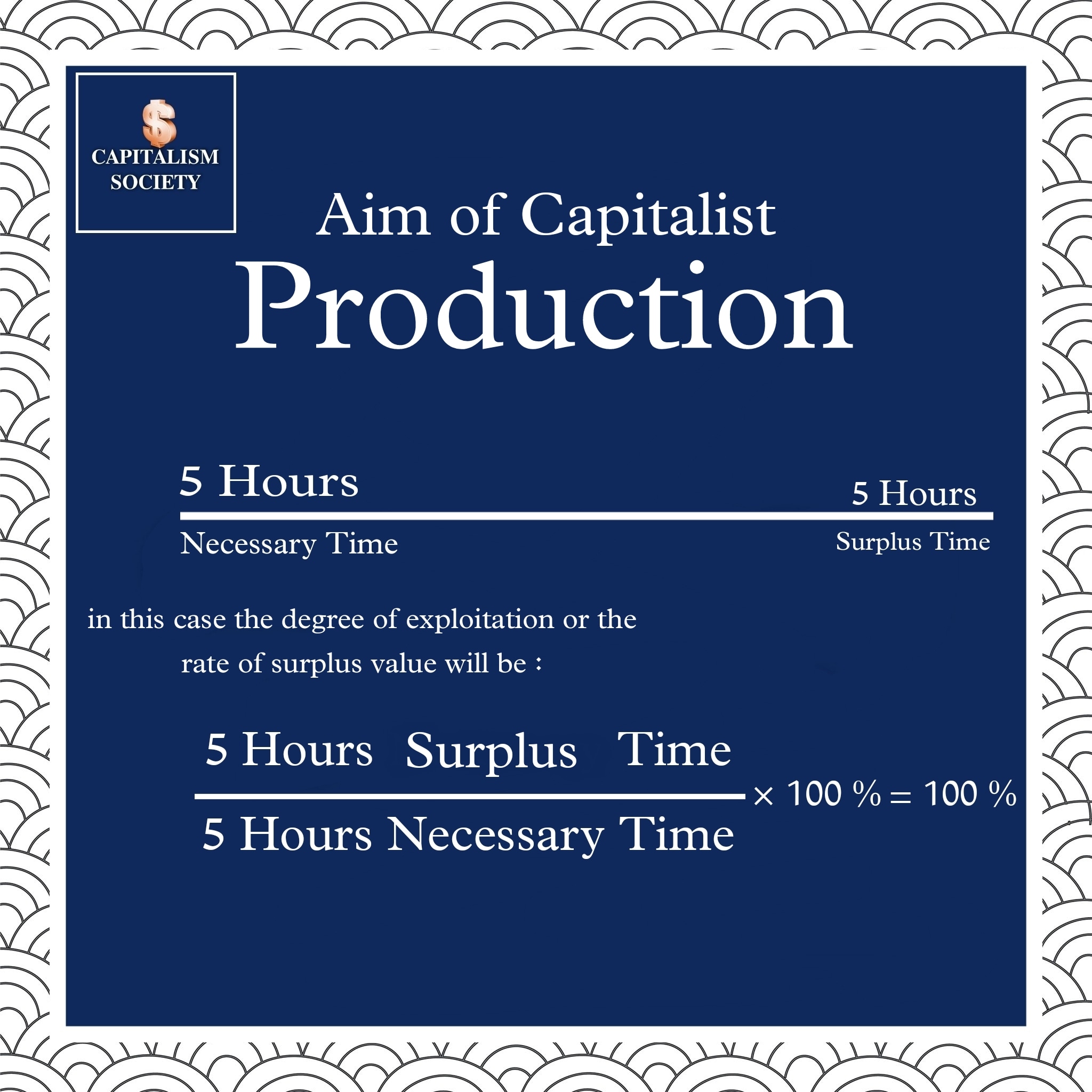
The conversion of surplus value into capital and its use for producing new surplus value is the aim of capitalist production . Capitalists always strive to obtain as much surplus value as possible with the least possible expendi tures . They use every possible means to achieve this aim . Capital displays inordinate greed for surplus labour . Accord ing to a British trade union leader , capital fears the absence of profit or too small a profit as nature fears a vacuum , but as long as there is a sufficient profit , it becomes audacious ; if you guarantee capital a 10 per cent profit , it will agree to any application ; a 20 per cent profit enlivens it ; at a 50 per cent profit it is virtually ready to break its neck ; at a 100 per cent profit it tramples all human laws , and if it could make a 300 per cent profit , there is no crime which it would not risk even on pain of hanging . The pursuit of surplus value was a powerful stimulus to the development of production unknown to either the slave owning or the feudal society . This stimulus created a large scale industry first in Europe and in North America and then throughout the world . At the same time the pursuit of surplus value engendered contradictions between capitalists and the workers and imparted an antagonistic the character to the development of capitalist production . For a capitalist only that labour is productive which produces surplus value . In order to increase the surplus value each capitalist strives to squeeze as much surplus labour out of the workers as possible . There are two methods of increas ing the surplus value . Let us examine them on a concrete example . Let us assume that the working day lasts 10 hours of which 5 hours are the necessary labour time and 5 hours are the surplus labour time .

FIRST IMPERIALIST WORLD WAR

The signing of the Anglo – Russian agreement completed the creation of the Entente as an imperialist bloc of England , France and Russia . A period of bitter struggle between the two imperialist groups began . However , there were such great contradictions within the groups themselves ( disagree ments between Italy and Austria – Hungary over Tyrol , the Adriatic coast and other territories ) that Italy began to seek support from the Entente countries , and during World War I left the Triple Alliance and joined the Entente . There were disagreements also within the Entente . Russia was dissatis fied with the striving of England and France to prevent Russia’s access to the Black Sea Straits ( Bosporus and Dardanelles ) which had long been the aim of expansion of Russian tsarism . Despite the agreement on the division of spheres of influence in Africa reached by England and France , certain disagreements between the two countries persisted . The United States of America legally observed neutrality , although they actually sided with the Entente because they considered German imperialism the greatest threat to their own interests .