Aim of Capitalist Production

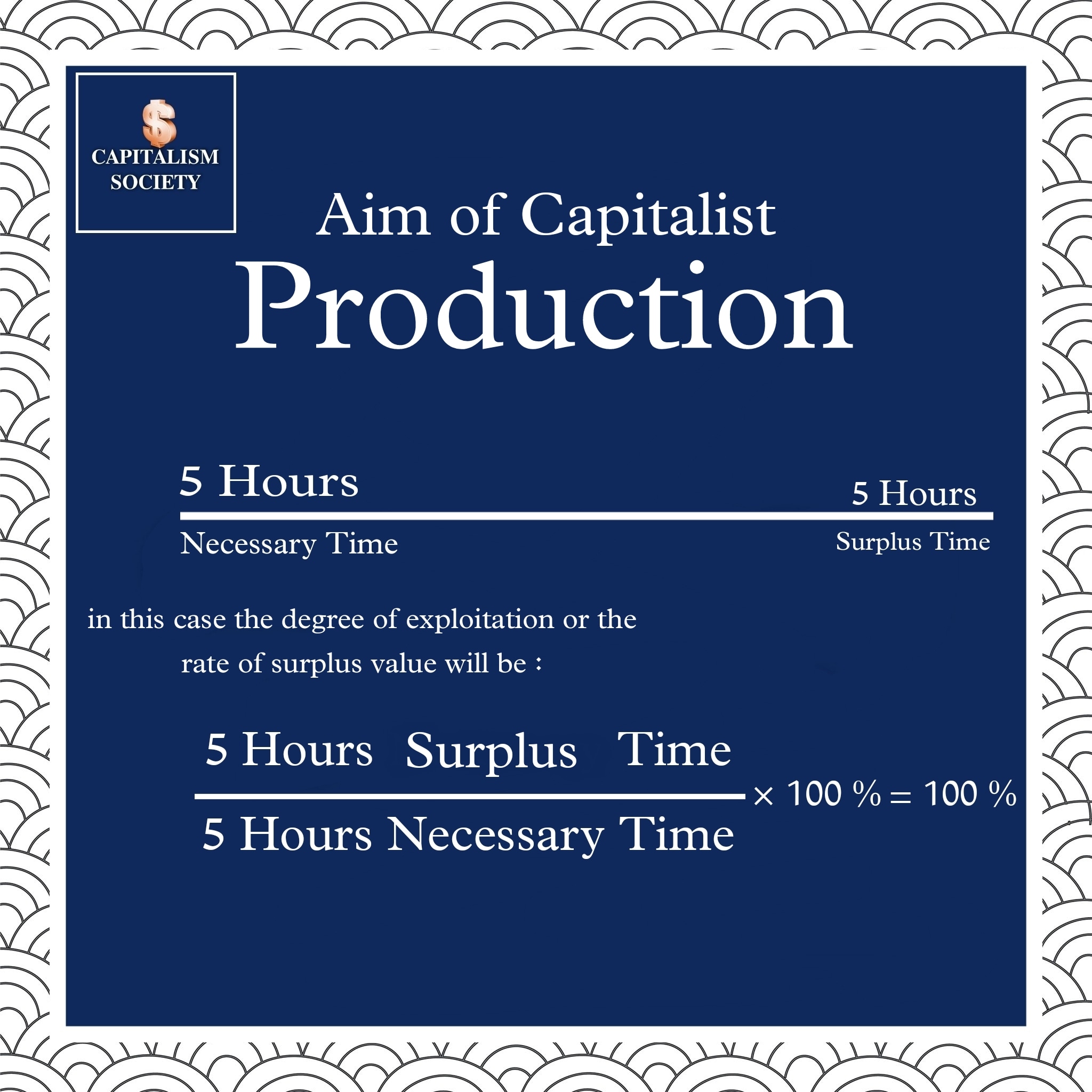
The conversion of surplus value into capital and its use for producing new surplus value is the aim of capitalist production . Capitalists always strive to obtain as much surplus value as possible with the least possible expendi tures . They use every possible means to achieve this aim . Capital displays inordinate greed for surplus labour . Accord ing to a British trade union leader , capital fears the absence of profit or too small a profit as nature fears a vacuum , but as long as there is a sufficient profit , it becomes audacious ; if you guarantee capital a 10 per cent profit , it will agree to any application ; a 20 per cent profit enlivens it ; at a 50 per cent profit it is virtually ready to break its neck ; at a 100 per cent profit it tramples all human laws , and if it could make a 300 per cent profit , there is no crime which it would not risk even on pain of hanging . The pursuit of surplus value was a powerful stimulus to the development of production unknown to either the slave owning or the feudal society . This stimulus created a large scale industry first in Europe and in North America and then throughout the world . At the same time the pursuit of surplus value engendered contradictions between capitalists and the workers and imparted an antagonistic the character to the development of capitalist production . For a capitalist only that labour is productive which produces surplus value . In order to increase the surplus value each capitalist strives to squeeze as much surplus labour out of the workers as possible . There are two methods of increas ing the surplus value . Let us examine them on a concrete example . Let us assume that the working day lasts 10 hours of which 5 hours are the necessary labour time and 5 hours are the surplus labour time .

The Development of Speech

Articulate human speech evolved in the processes of labour . Human thought and consciousness have the quality of abstract thinking , i.e. , a generalised reflection of reality in concepts , expressed in words . This capacity for abstract thought made it possible to express an idea , a sum of impressions in words , and with their aid man could inform other human beings of his impressions . However , this ability to communicate his thoughts to another human being through the aid of words was insufficient to stimulate speech . What was lacking was the necessity to communicate one’s thoughts to another . This necessity arose and developed in the process of man’s conscious labour . Labour was always a social activity . The work of a single human being was an integral part of the life of the human community . The unity of a commune of human beings in productive labour resulted in the fact that the individual in his mind , thoughts and actions regarded himself as a member of the commune , as subservient to it . That is why in the process of collective labour people felt the need to com municate with each other , to speak to each other . In the beginning , various shouts and cries used in the process of labour and arising from various actions were the sole means of communication . These cries gradually became established and remembered . This , in turn , brought about a change in the corresponding human organs . Under the in fluence of the pressing need to communicate in the process of common labour , the undeveloped throat was gradually transformed into an organ capable of producing articulate sounds . Thus , as a result of collective labour over a great period of time , articulate speech gradually evolved as a means of exchanging thoughts , as a means of human associa tion . Speech was of tremendous significance in the further development of society , since it helped to unite man’s efforts in labour as well as in organising collective labour ; speech made it possible for man to retain and pass on to coming generations his labour experience . Since the history of primitive society is a history of small , isolated human communities , the language of each such com munity developed independently and was unlike the language of other communities .

The Biological Relationship Between Man and the Animal World

In the 19th century archeologists discovered the remains of extinct , highly developed primates called Dryopithecinae , or tree apes . Charles Darwin , the great English naturalist , and his followers analysed the evolution of the animal world over the course of many centuries and used these discoveries to scientifically prove the biological relationship between man and the animal world , as well as man’s evolution from the highly developed tossil apes . The proof of this theory was to be found in the data provided by anatomy , embryology , paleontology and , specifically , by the basic similarity of skel etal structure , brain development and the composition of the blood of modern man and the anthropoid apes . The develop ment of modern science has proved the validity of this mate rialist theory magnificently .

Germany On The Eve Of The Revolution

Germany On The Eve Of The Revolution

Germany on the Eve of the Revolution In the 1840s there had as yet been no bourgeois revolution in Germany. The country was broken up into a number of independent states. The German Union formally unified 34 German states and four free cities. The supreme body of the Union was the Bundestag which exercised practically no power; It had no army, no legal rights and no diplomatic representatives abroad. The decisions of the Bundestag came into effect only after their approval by the heads of all the states and cities. In other words , no centralized state – basis for the development of capitalism – had as yet formed in Germany ; The country had no single internal market and the trade relations between the various German states were hampered by customs barriers. Under those conditions the development of capitalism in Germany encountered great difficulties . A customs union unifying 18 German states with a population of 23 million formed only in 1818-34 . The industry and cities developed slowly . For example , in the 1840s the 12 largest cities of Germany had a slightly larger population than Paris . In the middle of the 19th century the industrial revolution in Germany was only going through its initial stage. The German bourgeoisie was faced with the problem of carrying out a bourgeois revolution , creating a centralised state and winning power . However , the cowardly German bourgeoisie preferred not to raise the question of altering the political system , but to pursue a course of reforms . The German working class , which developed later than the working classes of England and France , began its struggle in the middle of the 19th century ; it tried to set up its own organisations and came out with its own demands . Owing to the severe police regime the German workers set up their organisations abroad , in Switzerland and England , where the political system was more democratic , and tried to guide the working – class movement from there . One of these organisations was the German People’s Union but , like the others , this organisation had weak ties with the workers of the German states and therefore could not exercise any practical guidance of the working – class movement . At the same time the workers began to struggle for their rights openly . The workers of Silesia ( the best developed area in Germany ) who lived under intolerable economic conditions rose against the capitalists in 1844 , but the government immediately dispatched troops to defend the interests of the exploiters . In the middle of the 19th century German industry advanced from the manufactory stage to machine produc tion , and its further development now depended on how rapidly feudalism was abolished in the country . Since the the necessary reforms , a government of the German Union was unwilling to carry out Germany . revolution was impending in Germany.

Landowners ‘ Way of Development of Capitalism

Landowners ‘ Way of Development of Capitalism

The second way of development of capitalism in agriculture is slower and harder for the peasants . In this case the landowners remain the dominant force in the countryside and , as a rule , in the whole of the country . The greater part of the land is owned by landowners , while the peasants are transformed from serfs into farm hands or tenants . Only a negligible number of rich peasants embark on the path of capitalist exploitation and use hired labour . This way of capitalist development in agriculture is connected with the existence of reactionary political systems , domination of the landowners ‘ class . The most typical of this way of capitalist development in agriculture were Germany , especially Prussia , and tsarist Russia . Neither in Germany nor in Russia ( until 1917 ) was the agrarian problem solved in a revolutionary way . That is why the development of bourgeois relations in the agriculture of these countries was the result not of a revolutionary over throw of feudalism , but of a slow and tormenting for the peasantry development of serf forms of exploitation into capitalist forms . In Prussia serfdom was abolished in 1806 , but the feudal obligations actually existed until the middle of the 19th century . A law on redeeming the feudal obligations was passed only in 1850 , and the peasants paid the land owners 1,000 million marks . These enormous sums received by the landowners from the peasants accelerated the trans formation of the landowners ‘ estates into capitalist farms and at the same time ruined many peasants . A similar picture was observed in Russia after the ” emancipation ” of the peasants in 1861 . The landowners ‘ way of development of capitalism in agriculture means persistence of the survivals of feudalism in the economy and the political system of the state . Elimina tion of these survivals becomes one of the objectives of the revolutionary movement .

Capitalist Industrialisation

Capitalist Industrialisation

The essence of the industrial revolution was the creation of a large – scale industry , i.e , industrialisation , which was aimed at building a technical basis appropriate to the pro duction relations of capitalism . However , capitalist industrialisation , as part of capitalist production , was governed by the principal economic law of capitalism – production of surplus value . That is why in the capitalist countries the industrial revolution began in the light industry where , in virtue of the rapid capital turnover , it was possible to make profit more quickly ; only as capital accumulated was it directed into the heavy industry . The capitalist countries were industrialised primarily through the plunder of their colonies . This applies particularly to England and France . Foreign loans are another means of building the industry . Lastly , industrialisation was carried out in a number of cases partly at the expense of the vanquished country . For example , Germany used the indemnities received from France after the Franco – Prussian War to build its large – scale industry . But in all cases , a large – scale industry in capitalist countries is also built through ruination and plunder of the country’s own people , i.e. , increase in taxes , dispossession of peasants , intensified exploitation of workers , etc.

Classical German philosophy

Classical German philosophy

By the middle of the 19th century the natural and social sciences had reached such a level of development that it was possible to create a truly scientific philosophy – a science about the most general laws of development of nature and society . The natural sciences showed that the world had not been created by anybody , but had developed according to its own laws . For example , physics discovered the law of universal gravitation which governs all natural phenomena , while chemistry discovered the law of conservation of matter , according to which nothing is created in the world and nothing disappears without leaving a trace , everything merely changing the form of its existence . The advance of natural sciences helped the further development of materialism and dialectics . The greatest contribution to materialist philosophy was made by the German philosopher Ludwig Feuerbach ( 1804 1872 ) . Georg Wilhelm Friedrich Hegel ( 1770-1831 ) , another German philosopher , generalised the method used by the modern sciences in analysing the phenomena of nature and society and raised dialectics to a new level ; according to Hegelian dialectics everything must be considered from the point of view of continuous change and development . However , neither Feuerbach nor Hegel could create a truly scientific philosophy . Feuerbach , for example , did not recognise dialectics and thereby rejected the method of cognition used by science , whereas Hegel adhered to idealist positions and persisted in the opinion that , according to the laws of dialectics , it was not nature and society , but some Absolute Idea that developed . Moreover , he limited the development of this idea to the creation of the Prussian constitutional monarchy , considering it the highest expression of the Absolute Idea and the acme of development of society .